2026 Best Drainage Pipe Types for Global Buyers
Choosing the best drainage pipe in 2026 requires more than comparing prices or wall thickness. Global buyers face different soils, rainfall patterns, installation skills, and compliance requirements. A pipe that performs well beneath a European road may fail in expansive clay or tropical heat. There is no universal winner.
The World Health Organization and UNICEF Joint Monitoring Programme reported that 3.5 billion people lacked safely managed sanitation in 2022. The World Bank’s Wastewater: From Waste to Resource report also estimated that more than 80% of global wastewater was released without adequate treatment. These figures show why reliable drainage infrastructure remains a practical development priority, not merely a construction detail. PVC-U, HDPE, reinforced concrete, ductile iron, clay, and corrugated metal each offer different strengths. PVC-U often provides smooth hydraulic flow and corrosion resistance. HDPE suits ground movement and challenging installation routes. Concrete handles heavy external loads, but transport and joint quality require careful planning.
This guide evaluates the best drainage pipe types for global buyers through service life, flow performance, installation risk, environmental exposure, and total cost. It also refers to recognised frameworks, including ISO 11296, ISO 4435, ASTM D3034, and relevant EN standards. Certification alone is not enough. Trench bedding, connection quality, and local workmanship can decide the final result. Sometimes, the cheapest pipe becomes the most expensive mistake. Buyers should verify product testing, factory traceability, project references, and local approval before ordering. These recommendations are useful, but site-specific engineering review remains essential.
Drainage Pipe Basics and Their Role in Modern Infrastructure
Drainage pipes are the quiet framework beneath roads, buildings, farms, and industrial sites. They collect stormwater, wastewater, or groundwater and move it safely away from structures. Without reliable drainage, water can weaken foundations, flood access roads, and erode soil around buried utilities.
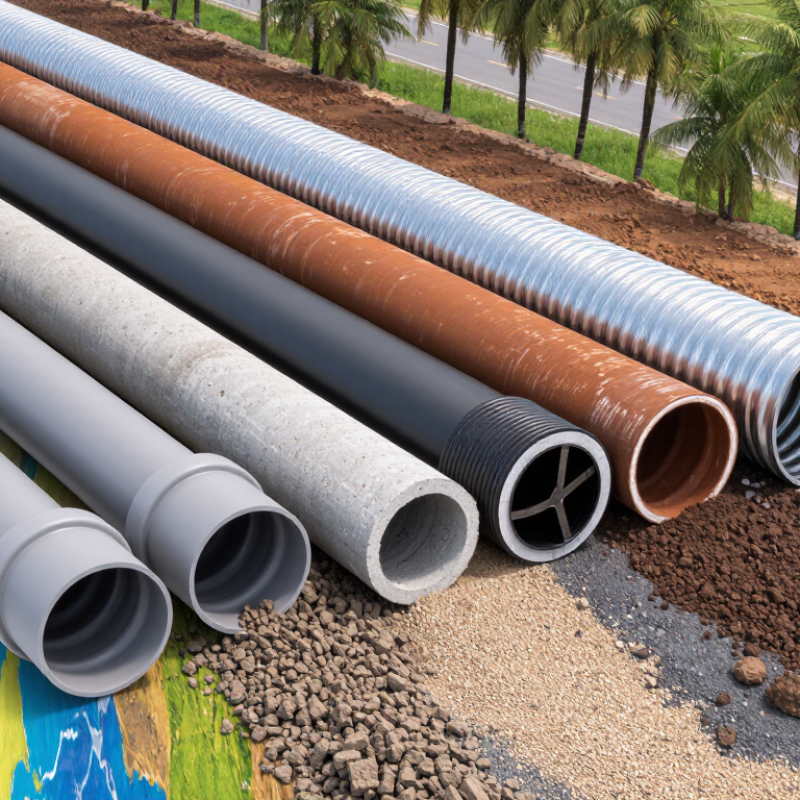
Common pipe types include PVC, HDPE, reinforced concrete, ductile iron, and corrugated metal. Each performs differently. PVC is lightweight and smooth inside, which helps reduce flow resistance. HDPE tolerates ground movement and is often practical for long buried runs. Concrete offers strength beneath heavy traffic, but transportation and installation require more planning. Perforated pipes can collect groundwater through small openings, while solid-wall pipes carry water toward an approved outlet.
Selection should begin with local conditions, not price alone. Check soil chemistry, expected flow, burial depth, traffic loading, temperature changes, and available installation skills. A coastal project may need stronger corrosion resistance. A cold region may require attention to frost movement and joint flexibility. Pipe diameter also matters; undersizing can create backups during intense rainfall.
Field experience shows that joints often fail before the pipe body. Clean connections, correct bedding, and careful backfilling are essential. Still, design assumptions can be wrong. Rainfall patterns are changing, and older flow records may no longer represent future storms. Global buyers should request test data, installation guidance, and traceable quality documents before ordering large quantities.
Main Types of Drainage Pipes for Different Global Applications
Global drainage projects need different pipe types, not one universal solution. Solid-wall PVC pipes suit gravity sewer lines and stormwater outlets where smooth interiors reduce blockage risks. Their light weight also helps crews work in narrow trenches. For heavier traffic zones, reinforced concrete pipes provide strong load resistance beneath roads and industrial yards.
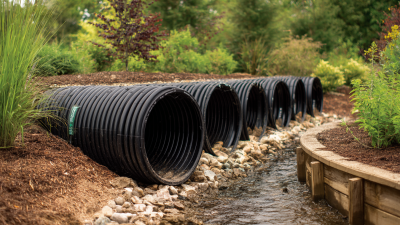
Perforated HDPE or PVC pipes collect groundwater around foundations, retaining walls, and agricultural fields. Wrap them with suitable filter fabric and place clean, graded gravel around the openings. Otherwise, fine soil can enter the pipe and reduce flow. Corrugated plastic pipes offer flexibility for roadside drainage and irregular ground, but their ribbed interiors may require careful slope planning.
Pressure drainage needs a different design. Double-wall or structured-wall pipes can carry stormwater over longer distances with lower material weight. In corrosive soil, nonmetallic materials often provide better durability than untreated metal. Local standards still matter. Temperature, burial depth, soil movement, and expected discharge should guide the selection.
Field experience shows that many failures start before installation. Poor bedding can create low points, while weak joints may leak during seasonal ground movement. I would not select a pipe from diameter alone. Project records, hydraulic calculations, and inspection access deserve equal attention. Some specifications look efficient on paper, yet they perform poorly when maintenance equipment cannot reach the line.
| Pipe Type | Typical Material | Common Diameter Range | Typical Applications | Key Performance Characteristics | Jointing Methods | Common International Standards | Main Advantages | Main Limitations | Relative Cost |
|---|---|---|---|---|---|---|---|---|---|
| Corrugated HDPE Pipe | High-density polyethylene with a corrugated exterior and smooth or profiled interior | Approximately 100–3,000 mm; larger diameters are available for engineered projects | Stormwater drainage Road culverts Agricultural drainage Retention systems | Lightweight, flexible, corrosion-resistant, good hydraulic efficiency, and suitable for buried installation when properly designed | Rubber-gasketed bells, couplers, electrofusion, butt fusion, or watertight fabricated connections | EN 13476; ASTM F405; ASTM F667; ASTM F2306; ISO 21138 | Easy handling, low transport weight, strong chemical resistance, and good resistance to ground movement | Requires suitable bedding and backfill control; may deform if installation compaction is inadequate; limited resistance to high temperatures | Low to medium |
| Solid-Wall PVC Sewer Pipe | Unplasticized polyvinyl chloride (uPVC/PVC-U) | Approximately 100–1,000 mm for common drainage and sewer products | Gravity sewers Building drainage Industrial wastewater Stormwater networks | Smooth internal surface, low friction, good dimensional stability, and high resistance to many domestic and industrial chemicals | Elastomeric gasket joints, solvent-welded joints for selected smaller systems, or mechanical couplers | EN 1401; EN 1329; ASTM D3034; ASTM F679; ISO 4435 | Reliable hydraulic performance, comparatively light weight, long service potential, and broad availability | Can become brittle at low temperatures or under impact; thermal expansion must be considered; not suitable for every high-temperature discharge | Low to medium |
| Structured-Wall PVC Pipe | Profiled or multilayer PVC construction designed to reduce weight while maintaining ring stiffness | Approximately 300–3,000 mm, depending on profile and project requirements | Large-diameter sewers Stormwater collectors Trenchless rehabilitation Low-gradient systems | Low internal roughness, reduced mass compared with solid-wall alternatives, and available stiffness classes for buried service | Gasketed sockets, couplers, extrusion-welded joints, or project-specific fabricated connections | EN 13476; ISO 21138; applicable national sewer-pipe specifications | Efficient use of material, easier handling than many rigid large-diameter pipes, and good corrosion resistance | Product performance depends strongly on profile design and installation quality; not ideal for severe external loads without engineering verification | Medium |
| Reinforced Concrete Pipe | Concrete reinforced with steel bars, welded wire reinforcement, or steel fibers according to design | Approximately 300–4,000 mm; larger sizes may be manufactured for specialized infrastructure | Highway drainage Large storm sewers Box and culvert systems Deep-buried pipelines | High structural capacity, strong resistance to external loads, good fire resistance, and stable performance under many soil conditions | Tongue-and-groove joints, rubber-gasketed joints, sealed collars, or concrete-encased connections | EN 1916; ASTM C76; ASTM C361; AASHTO M170; ISO 7186 | Suitable for heavy traffic loads and deep burial; good dimensional stability; widely understood by civil contractors | Heavy transport and installation requirements; vulnerable to aggressive chemicals if not designed or protected appropriately; joints require careful alignment | Medium to high |
| Vitrified Clay Pipe | Fired natural clay with a vitrified, dense ceramic body | Approximately 100–1,200 mm for common sewer applications | Sanitary sewers Industrial effluent Aggressive wastewater Long-life gravity systems | Excellent resistance to many acids and chemicals, high abrasion resistance, and very low water absorption when properly manufactured | Factory-made elastomeric gasket joints, couplers, or approved sleeve connections | EN 295; ASTM C700; ISO 16043 | Excellent chemical durability, abrasion resistance, and long-term dimensional stability | Heavy and relatively brittle compared with thermoplastic pipes; requires careful handling, bedding, and alignment | Medium to high |
| Ductile Iron Pipe | Ductile cast iron with internal lining and external metallic or polymeric protection as specified | Approximately 80–2,600 mm for common pressure and drainage infrastructure | Pressurized drainage Pumping mains Flood-control systems Rail and road crossings | High strength, high impact resistance, strong resistance to external loads, and suitability for pressure or surcharge conditions | Push-on rubber gasket joints, restrained joints, mechanical couplings, or flanged connections | EN 545; ISO 2531; AWWA C110; AWWA C111; AWWA C151 | Excellent mechanical strength, suitable for demanding crossings, and available with restrained-joint systems | Heavier and usually more expensive to transport; corrosion protection and soil chemistry must be assessed | High |
| Corrugated Steel Pipe | Galvanized steel, aluminized steel, or polymer-coated corrugated steel | Approximately 300–3,600 mm; larger multi-plate structures are project-specific | Road culverts Agricultural crossings Temporary drainage Large water conveyance | High strength-to-weight ratio, rapid installation, and good structural performance when supported by suitable soil or backfill | Bolted or band couplers, flanged connections, or site-assembled structural plates | AASHTO M36; ASTM A760; EN 10219 for selected structural components | Fast installation, relatively light compared with concrete, and adaptable to culvert and crossing projects | Service life depends on coating, water chemistry, abrasion, and soil conditions; corrosion protection may be required | Medium |
| Stainless Steel Drainage Pipe | Stainless steel grades such as 304/304L or 316/316L, selected according to corrosive exposure | Approximately 25–1,500 mm, with larger fabricated systems available | Food processing Chemical facilities Coastal infrastructure Architectural drainage | High corrosion resistance, good temperature tolerance, smooth surface, and strong mechanical performance at relatively low wall thickness | Welded joints, sanitary clamps, press-fit systems, threaded fittings, or flanges | EN 10088; ASTM A312; ASTM A778; ISO 1127 | Excellent hygiene, durability, appearance, and resistance to many aggressive environments | High material and fabrication cost; grade selection is important in chloride-rich or highly acidic environments | High |
| Perforated HDPE or PVC Drain Pipe | Perforated corrugated HDPE, perforated smooth-wall HDPE, or perforated PVC | Approximately 50–600 mm for subsurface drainage; larger collector sizes are project-specific | Foundation drainage Sports fields Land drainage Retaining walls | Designed to collect groundwater through perforations; flexible installation options and strong resistance to common soil chemicals | Snap couplers, gasketed couplers, perforated fittings, or geotextile-wrapped connections | EN 50086-2-4; ASTM F405; ASTM F667; applicable national subsurface-drainage specifications | Lightweight, easy to install, corrosion-resistant, and compatible with filter gravel or geotextile systems | Requires correct perforation orientation and filter design; can clog in fine soils without suitable geotextile or aggregate protection | Low |
| GRP / Fiberglass-Reinforced Polyester Pipe | Glass-fiber-reinforced thermosetting polyester, vinyl ester, or epoxy resin systems | Approximately 300–4,000 mm; pressure and stiffness classes vary by manufacturer and design | Large stormwater lines Industrial wastewater Coastal infrastructure Pressurized drainage | High corrosion resistance, smooth bore, low weight relative to stiffness, and available for both gravity and pressure service | Rubber-sealed sleeve couplings, laminated joints, flanges, or restrained connections | EN 14364; ISO 10467; ASTM D3262; ASTM D3754 | Strong resistance to many chemicals, efficient hydraulics, and reduced lifting requirements compared with concrete or metal | Impact and handling procedures must be controlled; field modifications require trained personnel; performance depends on stiffness and installation design | Medium to high |

How to Compare Pipe Materials, Strength, and Service Life
Choosing drainage pipes for global projects requires more than comparing price per meter. Material, structural strength, installation quality, and service conditions must be assessed together. PVC offers a smooth interior and reliable flow in many gravity systems. It is lightweight, but cold temperatures and rough handling can increase cracking risks. HDPE tolerates ground movement well and uses welded joints that can reduce leakage. However, it may deform under long-term loads without proper bedding.
Concrete pipes provide strong resistance to traffic loads and external pressure. Their weight raises transport and installation costs. They also require careful joint sealing, especially where groundwater enters the trench. Polypropylene can perform well in chemically aggressive soils, but local temperature and load ratings still matter. Do not rely on material names alone.
Check the pipe’s ring stiffness class, wall design, joint system, and tested service conditions. SN4 may suit landscaped areas, while SN8 or higher may be needed beneath busy roads. Confirm soil type, trench depth, groundwater level, and expected vehicle loads. Bedding changes everything. A strong pipe can fail after poor compaction.
Service life is often estimated at several decades, but installation determines whether that estimate is realistic. Inspect samples for ovality, uneven walls, damaged sockets, and unclear markings. Ask for independent test reports and installation guidance. One practical lesson is easy to miss: the cheapest pipe may become the most expensive after repeated repairs. Still, specifications can be imperfect, and local engineers should verify assumptions before procurement.
Key Standards, Climate Factors, and Installation Requirements
Global drainage projects fail less often when pipe selection starts with standards, not price. EN 1610 defines sewer installation practices, including bedding, alignment, testing, and acceptance. ISO 21138 covers structured-wall thermoplastic pipes, while ASTM D3034 addresses gravity sewer PVC pipe. Local approval remains essential. A certificate alone cannot replace verification.
Climate changes the design margin. The WMO State of the Global Climate 2023 reported global temperatures about 1.45°C above the pre-industrial average. The IPCC Sixth Assessment Report states that atmospheric moisture rises approximately 7% for every 1°C of warming. Intense rainfall can therefore exceed older drainage assumptions. In flood-prone areas, buyers should check hydraulic capacity, joint tightness, and surcharge resistance. In freezing regions, burial depth must follow the local frost line. Flexible pipes may handle ground movement well, but poor bedding can still cause deformation. Soil chemistry matters too.
Installation quality is often the hidden cost. Use specified granular bedding, compact backfill in controlled lifts, and protect joints from stones. Maintain the designed gradient; a 1% slope is not universally suitable. Inspect the line with CCTV before commissioning, then perform leakage or pressure tests required by local codes. Site experience shows that rushed trench work creates more failures than pipe material alone. I would not treat a perfect laboratory result as proof of perfect field performance. Real projects are messier.
2026 Best Drainage Pipe Types for Global Buyers
Key standards, climate factors, and installation requirements
Standards commonly referenced: PVC-U: EN 1401 and ASTM D3034; HDPE: EN 12666 and ASTM F405/F667; PP: EN 1852; ductile iron: EN 598 and ISO 2531; concrete: EN 1916 and ASTM C76.
Installation priorities: Verify frost depth and thermal movement in cold climates, provide suitable bedding and backfill, control buoyancy in high-water-table areas, and follow the applicable national standard for slope, jointing, testing, and inspection.
How Global Buyers Can Select the Right Drainage Pipe in 2026
Selecting drainage pipe in 2026 requires more than comparing price per meter. A project begins with soil, rainfall, flow rate, installation depth, and expected service life. In field assessments, I check whether the pipe will face traffic loads, groundwater, chemicals, or repeated temperature changes. These details often expose a cheap choice as an expensive repair. Start with the site data.
For gravity drainage, smooth-wall PVC or polypropylene can reduce friction and simplify handling. Corrugated HDPE offers flexibility where ground movement is likely. Concrete remains practical for large diameters, heavy loads, and demanding public infrastructure. The correct option depends on stiffness, joint design, bedding quality, and maintenance access. Do not judge strength from wall thickness alone. A pipe can be strong, yet fail after poor compaction or misaligned joints. Ask suppliers for dimensional data, ring stiffness results, chemical-resistance information, and independent test records. Verify compliance with the destination market’s current standards.
Global buyers should compare total installed cost, not only factory quotations. Freight volume, customs documents, couplers, tools, and replacement availability can change the calculation. I recommend requesting a sample joint and installation instructions before approving a large order. Small tests reveal awkward seals, unclear tolerances, and weak packaging. Leave room for doubt. My checklist is not flawless. Climate data may be incomplete, and projected rainfall can change. A qualified local engineer should review hydraulic sizing and structural assumptions before purchase. That step is sometimes skipped, unfortunately.
Related Posts
-
10 Best Drainage Pipe Solutions: Enhance Efficiency by 30% and Reduce Flood Risks
-
Why is a Sewage Pump Essential for Effective Wastewater Management?
-
Top 5 Sump Pumps with Battery Backup for Ultimate Protection?
-
What is Pump Technology? Understanding Its Types and Applications Explained
-
What is the Best Float Pump for Your Needs?
-
Why Choose Float Pumps for Your Water Management Needs?