
7 Battery Sump Pump Buying Tips for Global Buyers
Floodwater rarely arrives at a convenient time. A failed primary pump can turn a basement into a serious property and safety problem within hours. NOAA’s National Centers for Environmental Information recorded 27 billion-dollar weather and climate disasters in the United States during 2024. That figure is not a global sump-pump forecast, but it shows why resilient water management deserves careful attention.
For international buyers, selecting a battery sump pump involves more than comparing motor power. Battery type, pump capacity, discharge height, alarm visibility, charger compatibility, and replacement-parts access all affect real-world protection. The U.S. Department of Energy explains that pump performance depends on operating conditions, while manufacturer curves show how flow decreases as head height increases. A pump rated at 3,000 gallons per hour may deliver much less through a long, narrow discharge line. Small details matter.
Relevant safety requirements should also be checked. IEC 60335-2-41 addresses the safety of electric pumps for liquids, while regional certification rules may differ. Buyers should request test reports, operating instructions, ingress-protection details, and clear battery specifications. Third-party laboratory evidence is more dependable than a dramatic product claim. Still, no report can predict every outage, flood, or frozen discharge pipe. That is an uncomfortable limitation. A strong buying decision combines published data with local rainfall patterns, basement depth, power reliability, and maintenance experience. This guide presents seven practical buying tips for comparing battery sump pump systems across markets, while recognizing that the cheapest option may become the most expensive during an emergency.
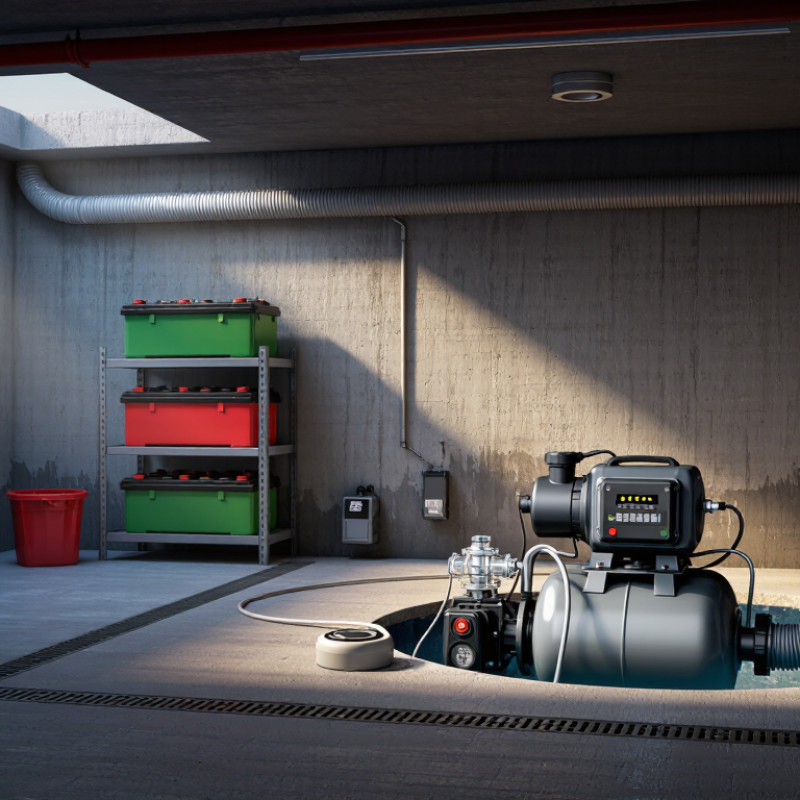
Assess Your Flood Risk and Sump Pump Requirements
Assess Your Flood Risk and Sump Pump Requirements
A reliable battery sump pump starts with accurate flood-risk assessment. Inspect your basement after heavy rain, not on a dry afternoon. Record water depth, inflow speed, and how often the main pump runs. FEMA estimates that one inch of indoor flooding can cause about $25,000 in damage. That figure makes capacity planning less theoretical.
Tip: Check local rainfall records, groundwater levels, and drainage conditions. NOAA’s 2024 U.S. Billion-Dollar Weather and Climate Disasters report recorded 27 costly weather events, showing how quickly extreme rainfall can overwhelm normal drainage. Global buyers should also review municipal flood maps and local building guidance. A coastal property, hillside home, and low-lying urban basement need different protection.
Measure the vertical lift from the pump to the discharge outlet. Add pipe length, bends, and backflow resistance. These details reduce real flow. Select a pump by tested litres per minute at that total head, not by its maximum label. For backup use, calculate expected runtime during a power outage. The U.S. Department of Energy recommends checking battery performance under realistic loads, rather than trusting advertised capacity alone. That is easy to overlook.
Tip: Choose a battery system with an alarm, automatic activation, and corrosion-resistant components. Test it monthly by lifting the float manually. Replace weak batteries before storm season. I have seen owners test the pump, but not the discharge line. That mistake can leave a working pump pushing water nowhere. Consider a second pump only after confirming the first system’s actual flow and installation quality.
7 Battery Sump Pump Buying Tips for Global Buyers - Assess Your Flood Risk and Sump Pump Requirements
| No. | Buying Tip | What to Assess | Useful Data or Benchmark | Recommended Requirement | Priority |
|---|---|---|---|---|---|
| 1 | Estimate flood and water-inflow risk | Review local rainfall intensity, groundwater level, drainage conditions, basement depth, and previous flooding. Consider whether the area is exposed to storms, power outages, or coastal flooding. | A rainfall depth of 1 inch over 1,000 sq ft produces approximately 623 gallons of water before losses. Actual sump inflow depends on soil, foundation drains, and groundwater. | Use a higher-capacity backup system for high-groundwater locations, low-lying properties, and buildings with frequent or severe storm events. Combine the pump with a high-water alarm. | Critical |
| 2 | Match pump capacity to the required flow | Measure the required discharge rate and calculate the total dynamic head, including vertical lift, pipe length, elbows, check valves, and outlet restrictions. | Do not select a pump using its free-flow rating alone. Compare the pump's published flow at the actual operating head. Common residential backup pumps are often evaluated at approximately 8–15 ft of total head. | Select a pump whose rated flow at the measured head meets the estimated inflow, with a practical safety margin of about 20–30% where conditions are uncertain. | Critical |
| 3 | Calculate battery runtime | Check the pump's operating current, expected pumping cycle, outage duration, ambient temperature, and battery discharge characteristics. | Basic energy estimate: Battery watt-hours = nominal voltage × amp-hours. Usable energy is lower after conversion losses, aging, temperature effects, and the battery's safe depth-of-discharge limit. | Size the battery for the expected outage period plus reserve. For frequent or long outages, consider a larger battery bank or an automatically started generator, subject to local safety regulations. | Critical |
| 4 | Choose the correct battery chemistry and voltage | Compare compatible battery voltage, charging method, temperature range, installation position, maintenance requirements, and total cost over service life. | Common backup configurations use 12 V or 24 V systems. Lead-acid batteries are widely available but are heavy and may require ventilation. Lithium batteries are lighter but must use a compatible charger and battery-management system. | Use only the battery type and voltage approved for the controller and charger. Install lead-acid batteries in a suitable ventilated location and protect all terminals from accidental short circuits. | High |
| 5 | Verify installation and discharge compatibility | Confirm sump-pit dimensions, pump inlet clearance, discharge-pipe diameter, vertical lift, outlet location, check-valve position, and protection against freezing. | Residential sump systems commonly use discharge piping around 1.5–2 inches, but the correct size depends on the pump design and local installation requirements. Smaller or restricted piping can reduce delivered flow. | Keep the discharge outlet away from the foundation and prevent backflow. Use a dedicated discharge route where possible, and follow local plumbing, electrical, and drainage regulations. | High |
| 6 | Prioritize alarms and automatic changeover | Check for high-water, low-battery, pump-failure, charger-failure, and power-loss alerts. Determine whether notifications are local, remote, or both. | A battery backup pump should start automatically when the primary pump fails, the water level rises, or utility power is interrupted. Alarm contacts or communication features can support building-management systems. | Choose audible and visual alarms for occupied buildings. For unattended or high-value properties, add a monitored alert that can report a fault when no one is on site. | High |
| 7 | Plan testing, maintenance, and international compliance | Review service access, replacement-parts availability, battery replacement intervals, warranty terms, electrical protection, and conformity requirements in the destination market. | Test the pump and alarm at least every 3–4 months and before the local wet season. Inspect the battery, terminals, charger, float switch, check valve, and discharge line during each test. | Confirm compatibility with the local mains voltage and frequency, use appropriate residual-current protection, and verify applicable electrical, building, and environmental requirements before import or installation. | High |
Planning note: Pump performance, battery runtime, and installation requirements vary by model and site conditions. Always use the manufacturer's performance curve and follow applicable local codes.
Related Posts
-

How to Choose the Best Battery Sump Pump?
-
2026 Top Battery Backup Sump Pump Types to Buy?
-
How to Choose the Best Sump Pump with Battery Backup for Your Home
-
Top 5 Sump Pumps with Battery Backup for Ultimate Protection?
-
How to Choose a Sump Pump With Battery Backup in 2026?
-
China Top 10 Sump Pump With Battery Backup Suppliers